









Hairless, barkless, barely known, and now extinct in Guatemala: Maya Dogs
Posted September 23, 2024
by Sergio D’angelo Jerez
Almost nothing has been published about the Maya dogs in Guatemala, the hairless, barkless race that became very important in the Maya, and other Pre-Hispanic civilizations. These dogs were not only a part of daily activities, but they also gained religious symbolisms. As FLAAR Mesoamerica introduces you to one of the latest photo reports authored by Dr. Nicholas Hellmuh, learn through this blog about his travels in Alta Verapaz, and how he may be among the very few specialists that learned the most about these animals in Guatemala.
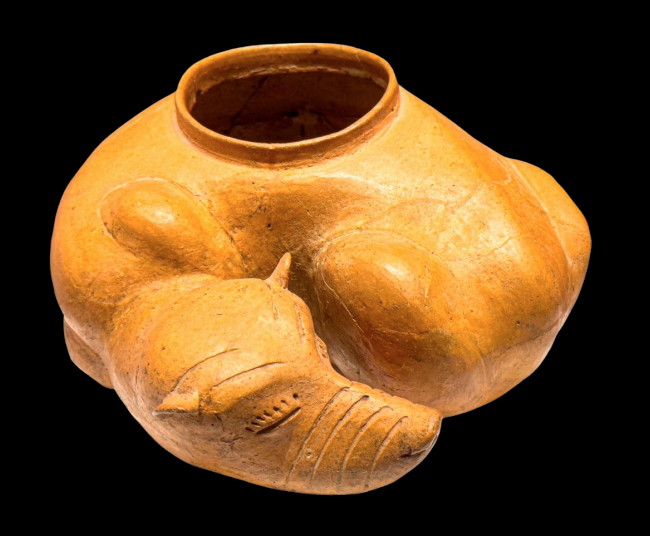 This dog-shaped vase is in the National Museum of Archaeology and Ethnology of Guatemala (MUNAE). FLAAR Photo Archive. |
Maya Dogs in Maya culture
As it is shown in different depictions found in Maya ceramics, dogs held an important place in Maya culture. Apparently, there were different kinds, of which some were used as hunting assistants, and others were bred for human consumption (Clutton-Brock 1994).
Furthermore, these dogs also gained relevance in Maya beliefs. Among these, they were seen as companions to the underworld, and the afterlife. They were also employed as substitutes for humans in sacrifices to the gods, which implied they had great symbolism (De La Garza, 2014). Lastly, they were also considered the beings that provided civilizations with fire, and as deities, they were represented in Xolótl, Quetzalcóatl’s twin brother (De La Garza, 2014).
Dr. Hellmuth looked for Maya Dogs in Alta Verapaz around 20 years ago
On September 19, 2024, Nicholas related, for the writing of this blog, how he went to Alta Verapaz to look for the Maya Dogs that may have been among the last that lived in Guatemala. This is what he shared:
Maya dogs are pictured in Late Classic Maya Art, specially on codex style vases, which are from northern Petén, and adjacent southern Campeche [in México]. The actual dogs still existed in Guatemala until about 20 years ago. For example, we talked to a person that had actually seen these dogs in Alta Verapaz [around that time]. He went with another colleague from that local area, so [when we decided to look for the dogs] we were able to go with that person (...) No four wheel drive vehicle would make it [there] so we parked our four wheel drive vehicle, and then we hiked for more hours, and more kilometers than I can remember. It was a long hike, it was incredible (...)
It was in Alta Verapaz, I think we parked our car in the area where a German or Swiss guy has married a local woman, and has a Quetzal viewing lodge, but it was walking into valley after valley, go up over a mountain, and walk down through a valley, cross a river, and hike another mountain, and then hike down. It was beautiful because it's an area that normally only local people see. By the time we got near the village, we were told that the dogs had died about 2 to 3 years before we got there. But as I said, they did exist in Guatemala. Of course they did exist in Mexico. I think in Peru there are still a lot of them, but in most countries, they disappeared.
It looks like they don’t have fur, of course they do, it is just very short, and their tale is kind of furry at the end. I mean, again, you can see them in codex style vases.
They were used for hunting, so you see plates and vases that show Maya hunters with the dog. And then, they let you into the underworld, I think that’s from the Popol Vuh, or somewhere similar, and also [in] a lot of Chamá vases that show a ruler being carried in what looks like a hammock. He is being carried by several people in the front, and several people in the back, and there's a dog under him (...)
In West Coast Mexico, it is estimated that these dogs were eaten; they were probably eaten everywhere. Some were bred to be eaten, some were bred for assisting in hunting, and other purposes.
 This was among Nicholas’ firsts visits to México, and Guatemala. Here he is at an airfield in Chiapas on his way to Bonampak for the first time. Although the dogs in the picture are not the Maya dogs, you can see that the local Maya Lacandón villagers were accompanied by their pet dogs. FLAAR Photo Archive. |
FLAAR’s photo report on Maya Dogs in Late Classic Maya Art
Recently, FLAAR and FLAAR Mesoamérica published a photo report on Maya Dogs in Late Classic Maya Art. It doesn’t surpass 10 pages in length, but it showcases a collection of photos from the FLAAR Photo Archive of Maya ceramics with depictions of Maya Dogs. Through the photos, aspects such as common features pictured in different vases, and ornaments based on the real-life morphology of the dogs are discussed.
For instance, the report includes photos that show the following characteristics. First, most of the “fur” of the Maya Dogs is on the end of their tail. Second, most of the vases have parallel indentations in the snout of the dogs, and wrinkles in other parts of their body (Hellmuth, 2024).
To conclude this blog, it may seem that this topic hasn’t been of the greatest interest for other archaeologists, but FLAAR Mesoamérica shares these aspects so maybe in the future someone does dive deeper into it. After all, there are plenty of Maya ceramics that demonstrate that in fact these animals were just as relevant in Maya culture as they are today.
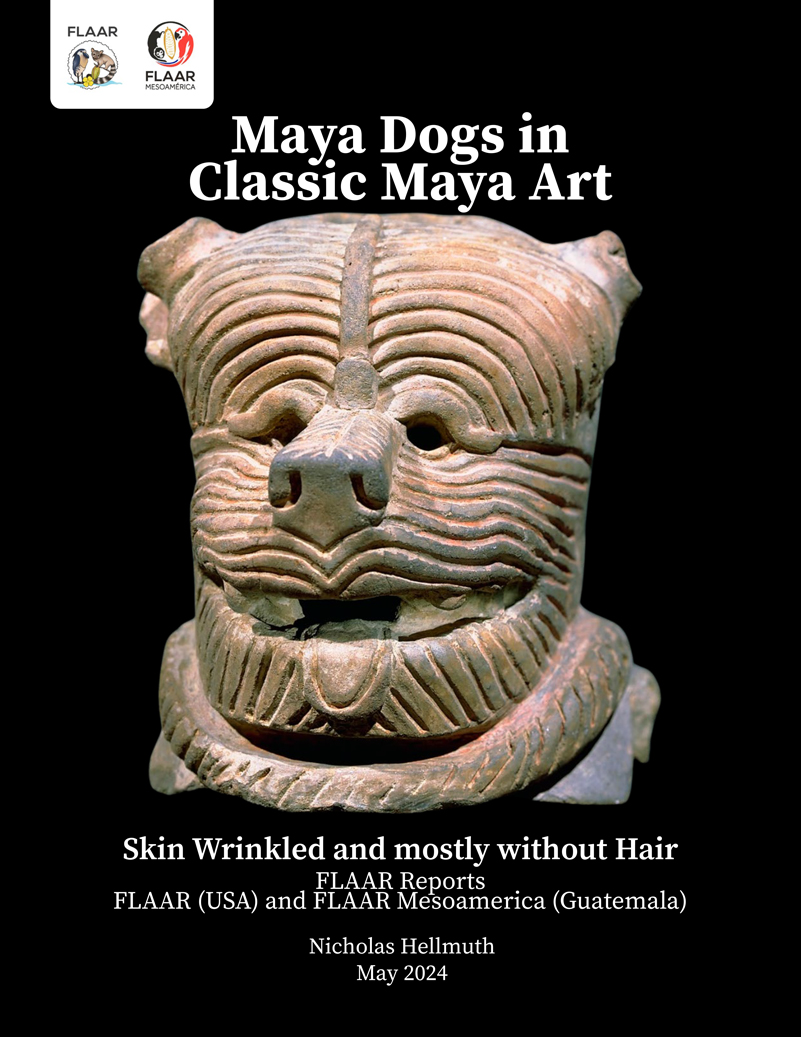 Chek the Photo Report about Maya Dogs in Classic Maya Art |
References:
- 1994
- Hot dogs: comestible canids in Preclassic Maya culture at Cuello, Belize. Journal of
Archaeological Science. 21.6. 819. AnthropologyPlus. U of Kansas, Lawrence. 11 Sept. 2008
http://firstsearch.oclc.org.www2.lib.ku.edu
- 2014
- El carácter sagrado del xoloitzcuintli entre los nahuas y los mayas. Arqueología
Mexicana, vol. XXI (125).
https://arqueologiamexicana.mx/mexico-antiguo/el-caracter-sagrado-del-xoloitzcuintli-entre-los-nahuas-y-los-mayas
- 2018
- Dogs in maya civilization. Mayantoons.
https://www.mayantoons.org/index.php/2018/03/20/dogs-maya-civilization/
- 2024
- Maya Dogs in Classic Maya Art. Guatemala. FLAAR, FLAAR Mesoamérica.
https://flaar-mesoamerica.org/wp-content/uploads/2024/06/Maya-Dogs-in-Classic-Maya-Art-May-2024-NH.pdf