It is well known that the pre-Columbian Maya colored their cacao beverage bright red with dye from the achiote seed pod. I would call it more a food colorant rather than a flavoring.
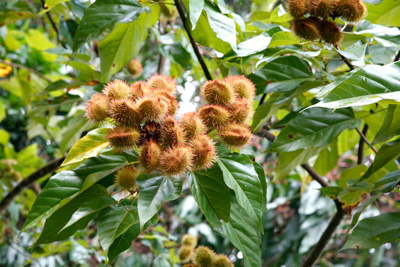
Achiote (Bixa orellana), annotto or annatto in Maya ethnobotany.
 |
Achiote (Bixa orellana) seeds in the canasta in the center. The plastic-wrapped achiote paste is how it is sold in Supermercado La Torre, Guatemala City. I was very surprised to see achiote sold in a modern supermarket, and noticed how informal the "wrapping" was (no brand, no description; just a chunk of the paste hand-wrapped in plastic). |
 |
Bixa orellana, achiote, close-up macro view from Coban Maya market, June 14, 2011. |
Achiote (Bixa orellana) is a common bush or shrub around houses throughout Verapaz and Peten areas of Guatemala, especially in Alta Verapaz. I have noticed two kinds of achiote: a less common kind grown between Raxruja and La Union, en route to the Maya ruins of Cancuen, and the more common kind around Chisec, Alta Verapaz (on the highway from Coban to Sayaxche, Peten). Ethnohistorical records document that achiote was grown in these same regions when the Spanish first entered these areas.
 |
 |
|
|
My personal interest in achiote is because I have seen it for so many years as I drive along the highways and roads of rural Guatemala. Plus in the years that I did ethnohistorical research in the Archivo General de Indias (Sevilla, Spain) and Archivo General de Central America (Guatemala City), I noticed frequent references to achiote, especially when reading about villages in the Verapaz area.
And since I have been studying cacao, achiote is a natural extension, since achiote and cacao are often grown in the same fields. The Spanish conquerors commented that the Maya flavored and colored their cacao drink with achiote: red cacao drink!
I have seen the English word for achiote spelled and misspelled various ways:
Annoto, annotto, annato, annatto.
 |
|
|
Red colorant in pre-Columbian times was also derived from cochinal and logwood.
The prehispanic Maya had three sources of red colorants from natural sources.
- Achiote, annatto, Bixa orellana
- Logwood, Palo de Campeche
- Cochinal, from an insect that lives on cactus plants
Plus of course many other colorants. I list above only the three most common and the three from plant sources. There are also many other plants that give dye of diverse colors and more than three plants that give red.
Be careful with claims that the red color of the Maya temples and palaces came from plants. Merle Green Robertson's evidence at Palenque (Chiapas, Mexico) suggests that the red color of most Maya building exteriors came from clays or minerals. Howver the color "Maya blue" seems to be a mixture of plant dye (indigo) and mineral or clay pigment.
 |
FLAAR Photo Archive of Maya Ethnobotany
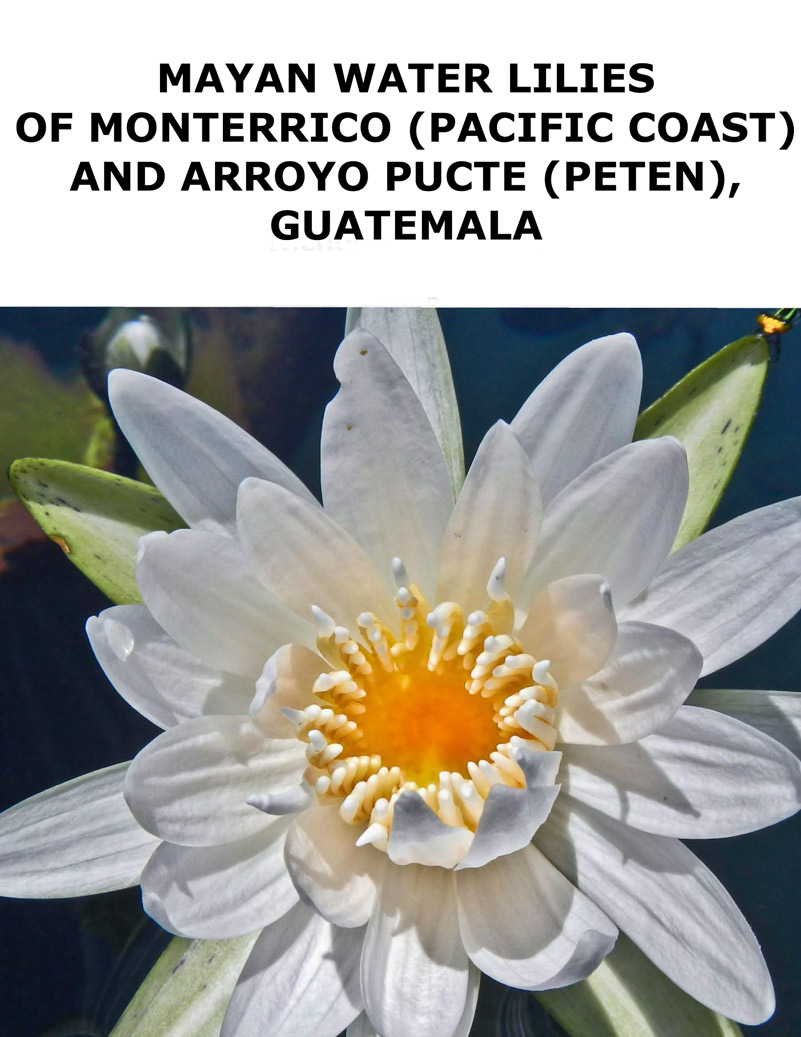
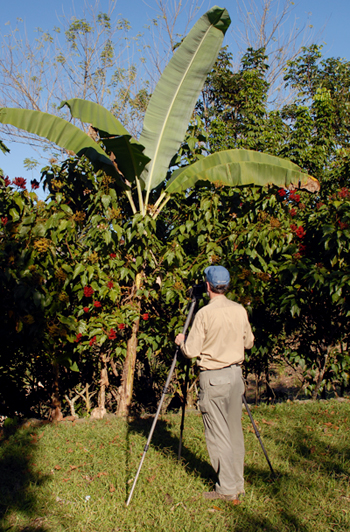
As time and funding become available more photographic coverage of achiote will be added to the FLAAR Photo Archive of Maya Ethnobotany. Presently this archive is primarily devoted to photographing cacao, water lily plants (especially flowers, seed pods, pads) and ceiba (especially the flowers and spines), so the photographs available on achiote so far we consider just snapshots, not formal studio-type photography of the kind that we accomplish with cacao.
I took some seeds of cacao and seeds of achiote from Mucbilha, Alta Verapaz. The cacao sprouted rather easily, but not a single one of the achiote seeds sprouted, even though the farmer kindly gave me seeds from his own seed bank. So we have a dozen young cacao trees now growing in the FLAAR research garden in Guatemala City, but not yet any achiote.
 |
If you wish to join Dr Hellmuth on a Maya ethno-botany field trip, and learn about tropical botany, Maya culture, and digital photography of flowers and nature, you can offer a financial contribution towards a portion of the project costs, plus cover your expenses during the field trip. Field trips can be a long weekend, a week, or 10 days. Please communicate by Skype flaar_mesoamerica or telephone (dial as for a USA number in Ohio) 1 419-823-9218 (our offices are in Guatemala and St Louis but we still use our Ohio numbers).
 |
 |
 |
|
Here are the different species of achiote.
|
||
If you are a student and wish to do thesis or dissertation work on Maya ethno-botany, or if you are a botanist or zoologist in any country, you are welcome to communicate with FLAAR by Skype flaar_mesoamerica. Our field office in Guatemala has two full-time bi-lingual biologists on staff plus the FLAAR Photo Archive of Maya Ethnobotany has an increasing number of professional quality photographs of plants and reptiles.
FLAAR is not a source of funding per se, rather we are a source of assistance and cooperation, with decades of field work experience in all ecological zones of Guatemala. You may wish to have one of our botanists assist you on your field trip. There is no fee for scholarly research under most conditions, though we do ask that you cover the normal day wage, local transportation, hotel and meals of any FLAAR biologists that you utilize while out on a field trip. If there would be shared joint publications resulting from this project, then the cost of the labor (day wage) will be refunded to you by FLAAR. Day wages in Guatemala are reasonable even with working on weekends or nights if necessary.
 |
|
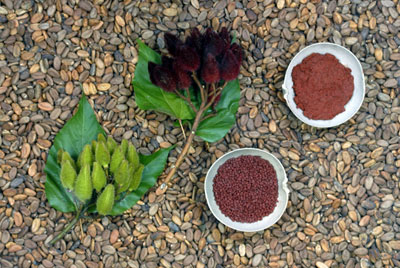
The Achiote was used by the mayan culture for red dye coloring and flavoring of cacao beverage. |
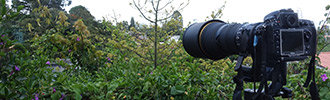
FLAAR also has 22-megapixel medium format digital cameras potentially available, for both studio photography of specimens as well as photography out on location. We have Nikon D300 and Canon EOS 5D plus a 48-megapixel large-format BetterLight (as well as professional quality reprographic stands for scanning specimens at high resolution). Our in-house Guatemalan staff has ample experience in operating these cameras, in our studio or out in the field (all are portable). It costs a lot less to rent these camera systems with a capable Guatemalan operator (who is also a biologist) then trying to bring comparable camera equipment from your home country and dragging it out into the field. Cost for this equipment requires insurance (a binder on your policy) and security (which we can provide) in addition to a nominal use-fee.
Photos added April 25, 2024.
First posted January 2008.
Updated January 5, 2009.
Edited August 24, 2009.