 |
|---|
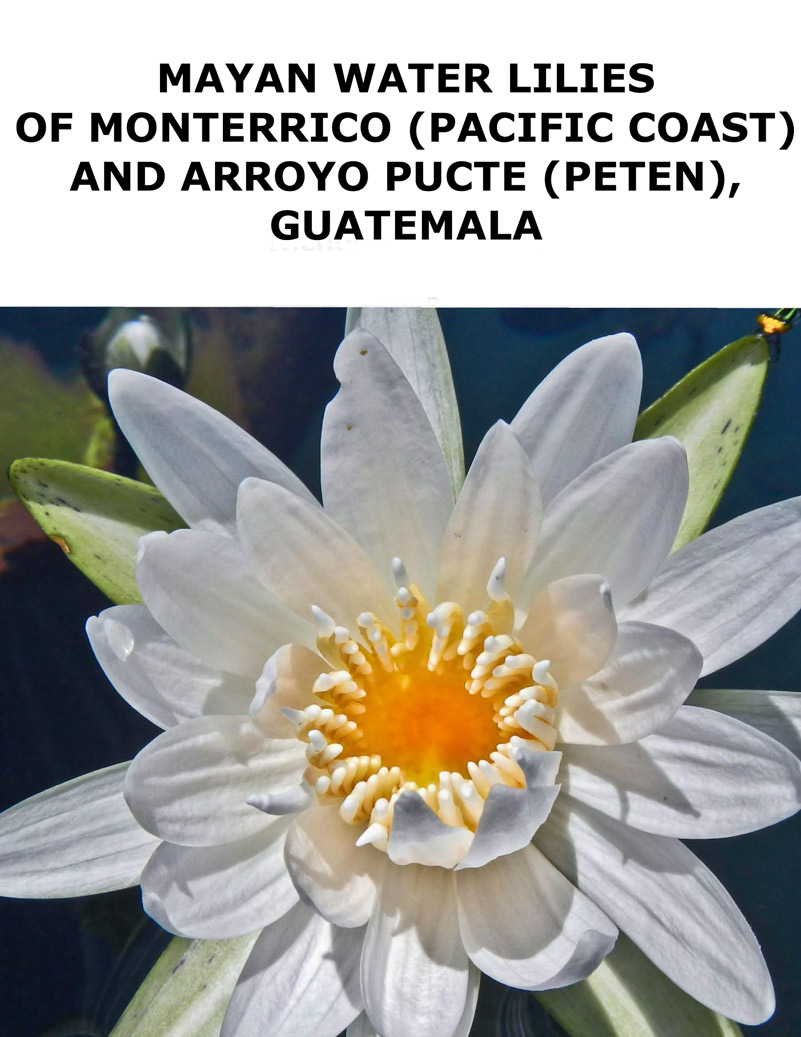
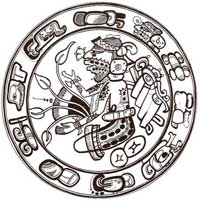
The water lily is pictured so often in Mayan art that it is clearly one of the top two or three most frequently rendered flowers during the Classic period of Peten. Stelae, altars, murals, and painted ceramics (vases, bowls, and plates) show water lily flowers.
This web page is not the place to question what part was eaten, smoked, ingested, or administered in an enema, but various parts of the plant are definitely edible. The Guatemalan biologist who was on the field trip (December 2007) ate parts of the plant because they had such a nice fruity smell. There were no adverse affects (though we would never recommend officially eating any unusual tropical plant; we don’t want to be responsible if the food disagrees with your system).
 |
 |
|
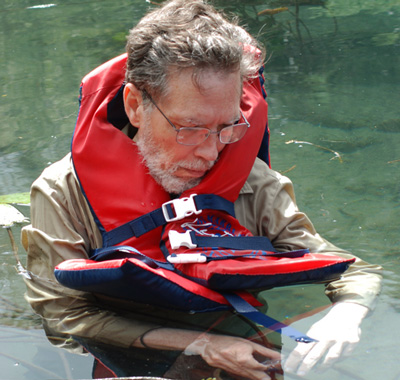
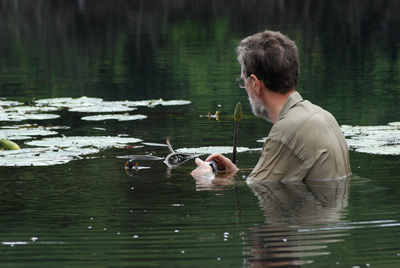
Nicholas Hellmuth taking underwater pictures at Peten.
|
Others in Peten say that there is a definite mild hallucinogenic effect if other parts of the waterlily flower are smoked. However our purpose is not to research drugs; the project is exclusively dedicated to testing digital photography equipment and ethnobotanical research on plants of utilitarian or food use in Maya agriculture of pre-Hispanic times.
 |
 |
|
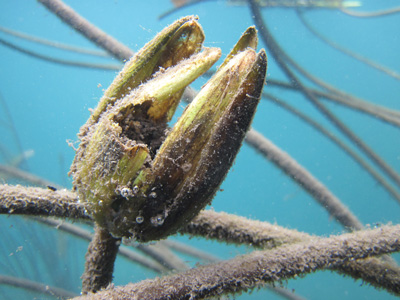
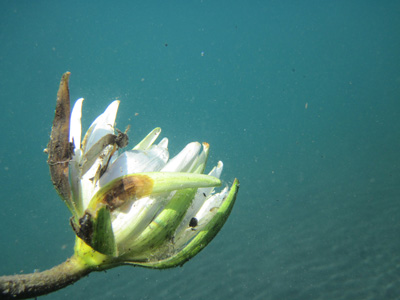
Under water pictures of water lily flower taken at Peten.
|
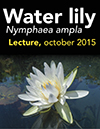
“Nape” is what the water lily, Nymphaea ampla, is called by local people in Peten.
Normally people call the flower “nympha”. In my Spanglish I tend to call it “lirio de agua” (I have no idea if this is a real word). But in December I noticed that Don Ernesto was calling the plants or flowers “nape.” Since in English this means “nape of the neck” I was unable to get a Spanish or Mayan translation on the Internet easily, since searches turn up the meaning of neck for a thousand pages. As soon as we get a “translation” of nape as a Spanish or Mayan word for water lily we will update this page.
 |
 |
|
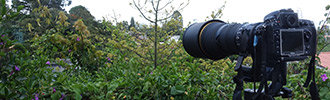
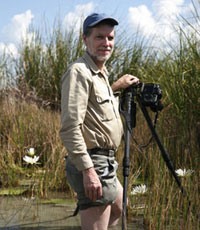
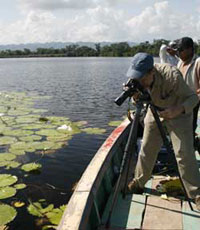
Here is Nicholas Hellmuth photographing water lily flower. Nicholas uses aPhase One P 25+ medium format digital camera back on a Hasselblad ELX camera with Zeiss lenses.
|
|
 |
|
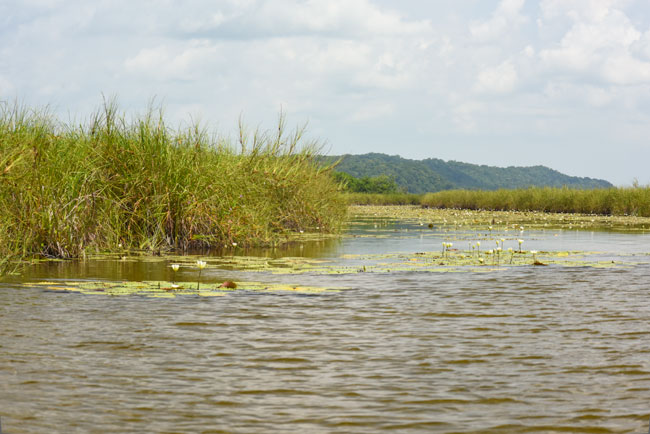
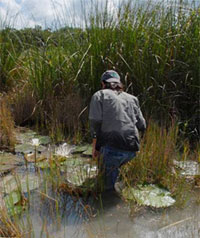
Here is a water lily area alongside the Rio San Pedro, downstream from Las Guacamayas Biological Station. But the massive areas of thousands of water lilies on this river is an hour downstream from Naranjo (about four hours from Las Guacamayas in boat).
|
FLAAR Photo Archive of Maya Ethnobotany.
The first two field trips we used only a Nikon D200 and Canon EOS 5D. The 22-megapixel Phase One P25+ was brand new, literally, had just arrived from Denmark and I had not used it yet. So it was utilized later, but not while we were in the canoe or out in the muck. Now, in 2015, we are using a 35 megapixel Nikon D810.
Because the water lily flower is bright white, it is always over-exposed in 90% of the photographs that exist. The pads, water, and especially the seed pods tend to be dark, so they are sometimes underexposed in comparison. We are working out digital methods to compensate by using HDR techniques (High Dynamic range). This will be explained in the FLAAR Learning Units
 |
|
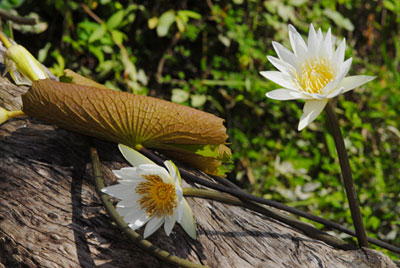
Water lily, Nymphaea ampla, moved onto shore to photograph because there was too much quicksand (silt) and we could not use a tripod out in the river.
|
Sometimes here will be two versions of our reports: a free version that is a photo-essay format; and a Learning Unit version that is part of our long-range training program in digital photography in general, and training for botanical photography in particular. But you don’t have to be a botanist to learn from FLAAR Learning Units: anyone who enjoys doing flower or nature photography can improve their techniques by looking at our examples.
Long range interest in the iconography and biology of the Maya water lily.
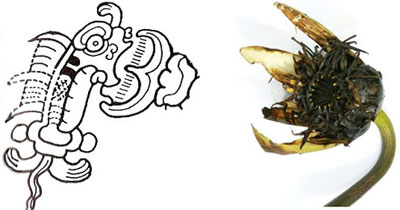
Much of my PhD dissertation circa 1985 was focused on the iconography of the water lily. Having a biologist (botanist) in the boat with me during 2007 was more helpful because Mirtha was able to provide a second-opinion as well as look at things through the eyes of a botanist. I tend to look at things though the eyes of an iconographer. By working together we made several breakthroughs in understanding the iconography of this beautiful flower.
 |
Between 2008 and 2013 we undertook additional studies of water lily plants and flowers, especially in Arroyo Pucte (Rio de la Pasion area) and Canal de Chiquimulilla (Monterrico, near Pacific coast). We will be giving two lectures on all our botanical discoveries in two lectures in Antigua Guatemala, 23 October 2015 in the evening and 30 October at 2:30pm.
We hope to find time to publish our findings in the future. But for now, the purpose of this new section on ethnobotany is to let botanists realize that if they need absolutely top professional quality photographs, images that are better than those available in stock photo collections, that FLAAR either has such photos available or can do special photography on commission.
Our photographs are fresh: photos in stock photo collections may be faded because negatives and transparencies naturally fade.
Our photos are digital from the start; photos in stock collections are scanned and thus have visible scanning artifacts. Photos from stock collections are unlikely as well color balanced as we can do today with a gray card.
FLAAR has three Guatemalan biologists on staff; they can survive camping and jungle and hiking. They are bi-lingual or tri-lingual. We also have Mayan speaking assistants. Any or all can be hired through FLAAR for your field trips. Email us at FrontDesk “at” FLAAR.org.
Between the first water lily field trip of 2008 and the most recent expedition (2015) we have several years of several field trips per year of intensive study of water lilies of Peten and Pacific Ocean inland waterways. But most important, we have experimented with different underwater cameras and equipment so we now have an unparalleled reference archive of photographs of the flower most frequently shown in Classic Maya art: the flower of Nymphaea ampla.
 |
 |
|
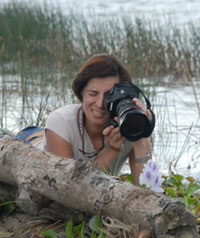
She is Mirtha Cano (biologist) photographing water lily in your natural habitat. She is using the Canon EOS 5D medium format digital camera. Mirtha has moved on to become a biologist at the Parque Nacional Tikal since this is closer to her family in the San Benito area of Flores.
|
|
Additional photographs added and page updated October 16, 2015
New pictures posted June, 2010
Checked August 24, 2009.
First posted January 2008.