FLAAR has developed unique capabilities in photographing Mayan hieroglyphic inscriptions. Our first photographs were the stelae of Yaxha, Peten, Guatemala. We used rudimentary lighting equipment, which was the custom among archaeologists at that time. This was 1970. We used rudimentary equipment as would be expected of a graduate student with a limited budget.
By 1980 we had advanced to using tungsten lighting and were recording inscriptions throughout Mesoamerica. By 1990 our equipment and experience were even better.
Circa 1994-1996 FLAAR received roughly $180,000 to photograph for a Japanese publisher. With this funding it was possible to buy virtually every kind of camera, lens, and lighting equipment that we could possible need at that time. For 18 months a photo team from FLAAR photographed in almost every archaeological museum in Mexico. The results in quality have not been surpassed since then for several reasons:
First, as an archaeologist and iconographer, we knew what parts of the sculpture should be brought out by lighting.
Second, it is rare that an archaeology expedition has the necessary professional level of photographic equipment. Since most projects are seasonal, and do not have a permanent headquarters, it is generally not realistic to bring down an entire photo studio to the site location.
Third, most archaeologists are busy teaching back at their home university or out in the field, and do not have time to gain experience with professional photography. Indeed I had to learn the hard way, by trial and error.
Fourth, there is an unspoken aversion to dedicating the kind of photographic treatment to an artifact that a professional commercial photographer would automatically devote to photographing a bottle of perfume or wine. There is an unwritten tradition among scholars that an artifact has an inherent value as a scholarly object, and that this historical importance will shine through even if you use a bed sheet as a backdrop and a simple bulb in a $1.99 aluminum reflector as your entire lighting system (this is how we started in 1970 at Yaxha).

As a result, most publications on artifacts have mediocre photographs. When hieroglyphs are published, usually the lighting is poorly aimed. In the cases where the photograph is done by a pro, it is usually one that usually does portraits of models, or fashion photography, but does not know how to bring out the details that an epigrapher or iconographer needs to see.
FLAAR photography techniques and technology is dedicated 100% to photographing archaeological artifacts and items of interest to anthropologists (such as indigenous construction techniques, ethno-botany, etc).
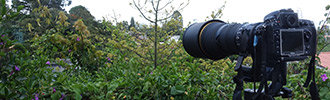
We have photographed the sculptures, ceramics, and artifacts of Copan over many years. Recently (2004) we returned again to Copan to showcase the benefits of using a medium format digital camera to record Classic Maya sculpture and hieroglyphic inscriptions.
A medium format camera in that year was 22-megapixels. Today they are 39-megapixels.
 |
|
Click to enlarge. Nicholas Hellmuth with the FLAAR photographic equipment during the shooting session at La Ruta Maya Foundation.
|
Last update February 8, 2010
First posted April 25, 2006.