In Guatemala and surroundings this flower is named Flor de Mayo and occasionally Flor de la Cruz. In English it’s often called frangipani. These Plumeria species are also named sacuanjoche, as the national flower of Nicaragua. The Plumeria flower (of many diverse species) is also practically the “national tourist flower of Hawaii” since it is the flower used in a lei for ceremonies and for tourists. The name Flor de Mayo is because the Plumeria flowers in May—but actually it often starts flowering in April. And I have seen Plumeria in Guatemala, out in the wild, flowering for many following months.
Zac nicte is white nicte and Chac nicte is red nicte (David Bolles Maya Yucateco dictionary). Plumeria alba and Plumeria rubra. This large shrub or small tree has a multitude of colors for its flowers. The native wild Plumeria is always white. The center is yellow—the amount of yellow depends on what part of Mesoamerica it is growing. Many different colors are also native to Mexico, Guatemala, and surrounding countries but these are raised in gardens. Bishop Landa noted several colors in Yucatan. Obviously today many botanical gardens have modern variants.
But so far we have not found Plumeria alba listed for Guatemala—only Plumeria rubra and Plumeria obtusa, and a variant.
The Maya word is spelled variously, nikte, nicte (usually with accents, which we don’t use since they don’t always print on some laser printer driver software).
Cacaloxochitl seems to be one designation in Nahuatl (academia.org.mx dictionary).
What we (Nicholas Hellmuth and biologist Eduardo Sacayon) were working on in the previous decade, was to create a reference archive of photographs of the actual flowers so that epigraphers and iconographers can more readily identify the stylized flowers that appear in Mayan art. We also want to provide iconographers, epigraphers and archaeologists with photographs and knowledge of lots of flowers native to the Maya areas so mis-identifications can be fewer. Many flowers and trees in Maya ceramics, murals and sculpture and hieroglyphs are mis-identified because not all scholars have been able to live for years inside the Maya rain forests and for decades to hike far into remote biodiverse ecosystems. J. Eric S. Thompson produced lots of helpful publications but he repeatedly claimed that the Kin hieroglyph was a Plumeria flower—but Plumeria has five petals. The Kin is a stylized 4-petalled flower—so not nikte whatsoever. We dedicated multiple field trips over many many years to find, photograph, and identify all the wild 4-petalled flowers that are native to Guatemala—and also flowers with 4-sepals and plants with four leaves in a geometric pattern. All those results are on-line—just Google 4-petalled flowers, Hellmuth, FLAAR.
This is a kind of research project well suited to FLAAR since we have several decades experience with photography out on location and are leaders in digital photography as well (see our www.digital-photography.org).
Since funding is scarce, our project moves ahead slowly. The interest in nikte flowers is because in Lacandon myths, recorded by earlier visitors, the Lacandon Maya of Chiapas specifically mention that certain of their gods were born of the nikte flower.
Habitat of Plumeria obtusa and Plumeria rubra in Guatemala
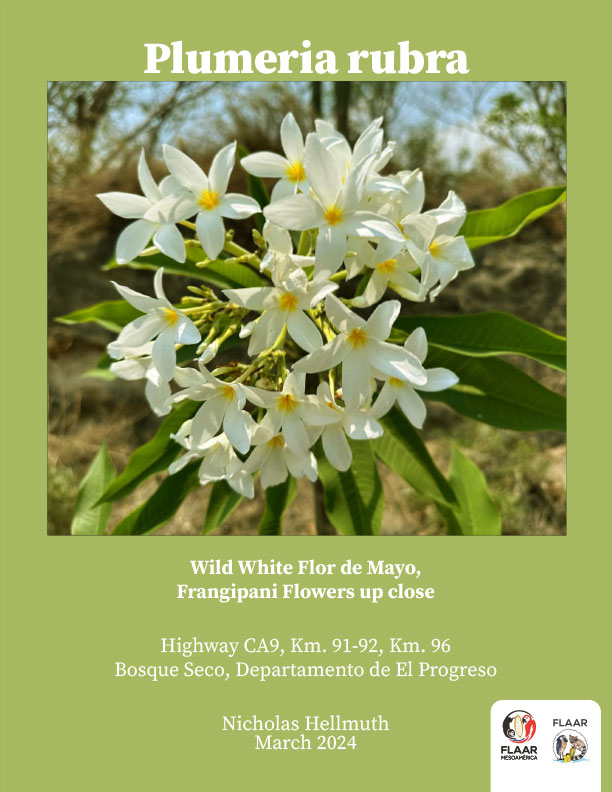
The highest concentration of Flor de Mayo in Guatemala is in the bosque seco, the arid area surrounding much of the Rio Motagua. You can also see hundreds of this plant in the eroded gullies on the highway leading to Coban, Alta Verapaz, just north of the turnoff from the Carretera al Atlantico.
I have transplanted about seven into my ethnobotanical garden in Guatemala City. But there the altitude is about 1500 meters and much more humid than their natural habitat. It takes them several years to adapt and in three years not one has bloomed. But in later years they began to bloom.
 |
|
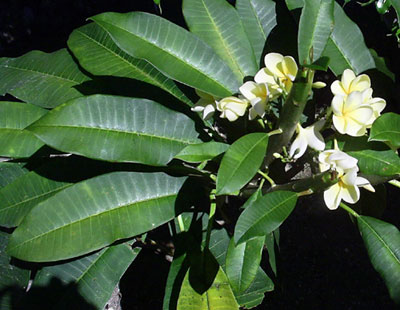
Plumeria, Flor de Mayo, photo by Mirtha Cano, FLAAR botanist 2007-2008.
|
 |
|
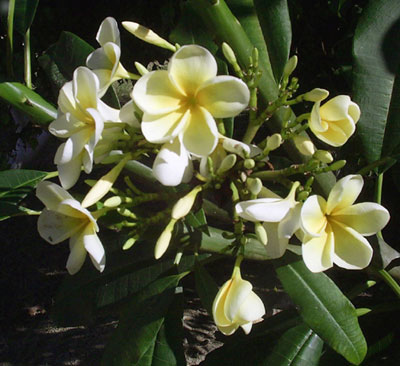
Plumeria, Flor de Mayo, photo by Mirtha Cano
|
Bibliography on Plumeria / nikte / nicte
There are enough web sites on Plumeria to keep you on the Internet an entire weekend. Plumeria.org is one of thousands.
Plenty of books are available too; we cite just two that were readily available when I was in Hawaii as a consultant on color management for inkjet printing two decades ago.
- 2000
- Handbook on Plumeria Culture. 4th Edition. Tropical Plant Specialists.
- 2006
- Growing Plumerias in Hawaii. Mutual Publishing.
Other sacred, revered, or culturally important flowers.
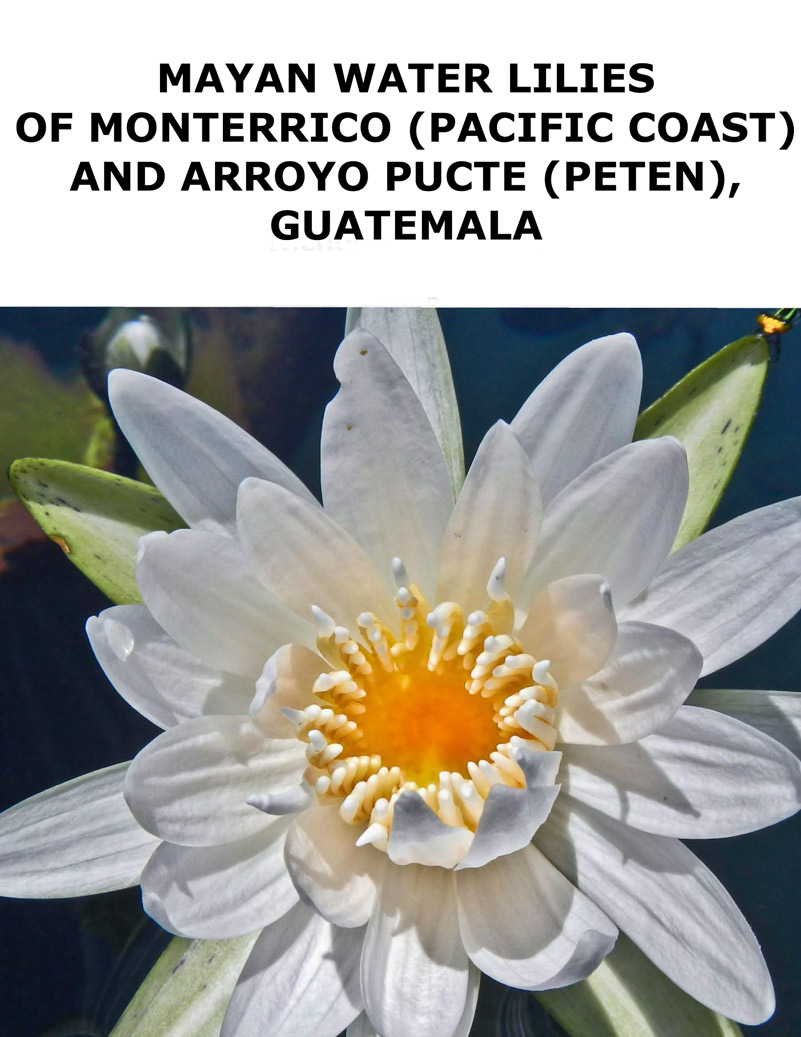
Additional flowers of interest are the water lily: on which my PhD dissertation was based, published by ADEVA, Graz, and now available as a download from our www.Maya-archaeology.org website. This is the original German edition with English intro and English captions. But what counts are the 727 illustrations; you don’t need to read Deutsch to appreciate the iconographic treasures available in this book. There is also a two-volume English edition as a download.
Other flowers considered sacred by the Maya include:
- Cacao was probably the most special plant to some Mesoamerican people other than maize.
- Additional flowers such as the Fleur de Lis are also evident in vase paintings, murals, and stelae. We have a long list of flowers that we are studying.
FLAAR is also studying all the original pre-Columbian seasonings for cacao, as listed in Maya and Aztec sources, as published by Sophie and Michael Coe. Many of these spices are from flowers.
FLAAR now has available several photo essay reports on Plumeria rubra and its relatives
|
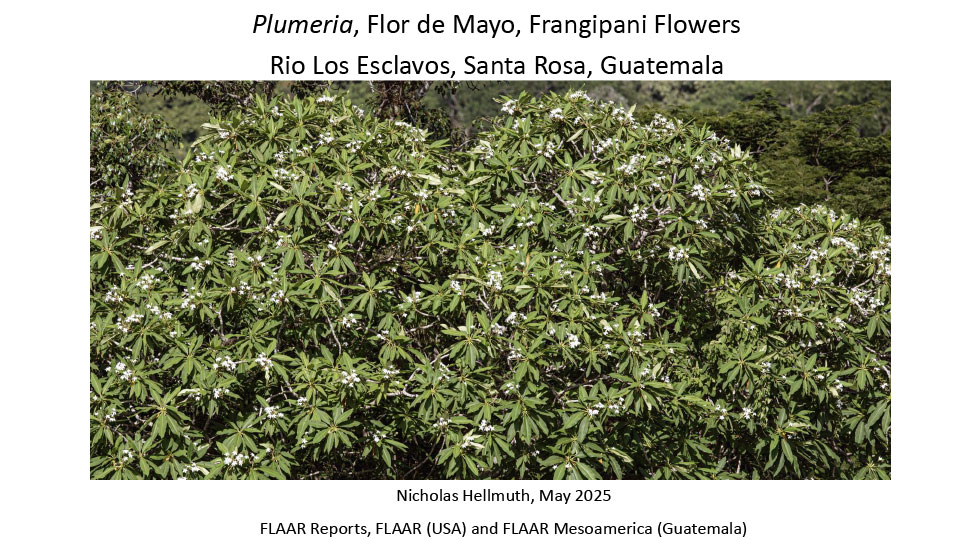
Plumeria, Flor de Mayo, Frangipani Flowers, Rio Los Esclavos, Santa Rosa, Guatemala. |
|
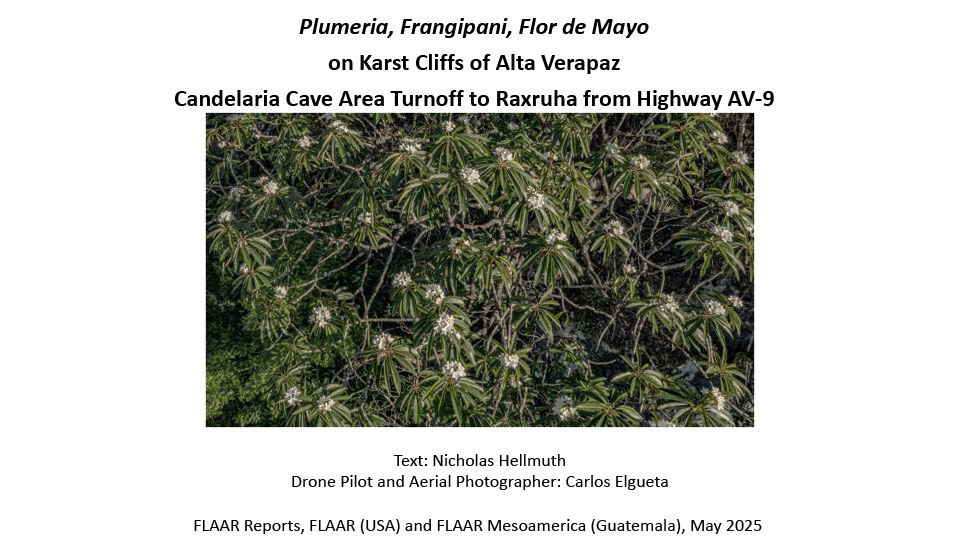
Plumeria, Frangipani, Flor de Mayo on Karst Cliffs of Alta Verapaz. Candelaria Cave Area Turnoff to Raxruha from Highway AV-9. May 2025 |
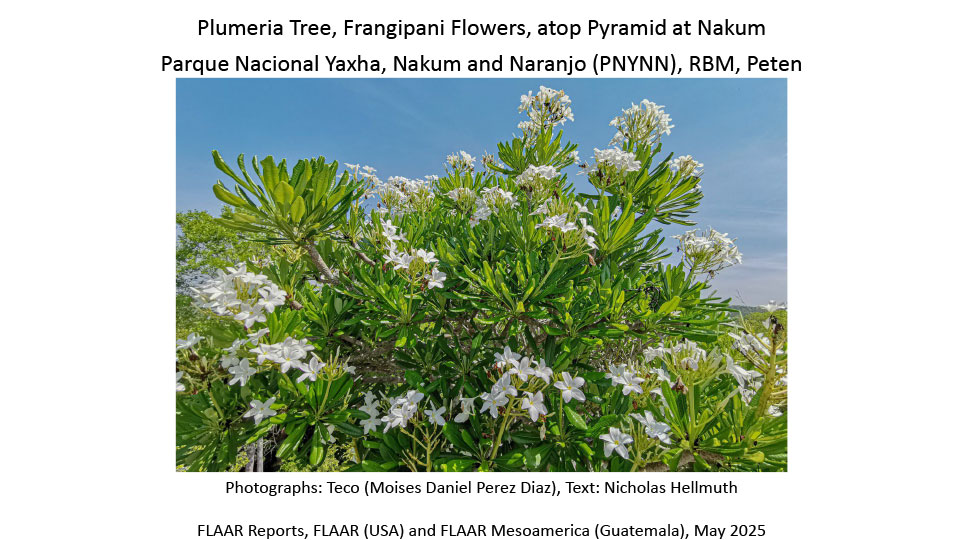
|
Plumeria Tree, Frangipani Flowers, atop Pyramid at Nakum, Parque Nacional Yaxha, Nakum and Naranjo (PNYNN), RBM, Peten. |
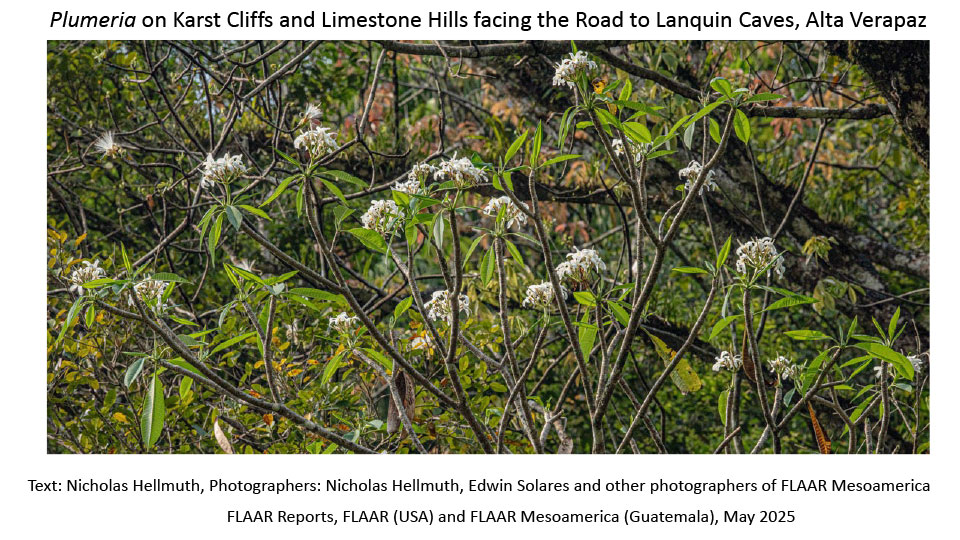
|
Plumeria on Karst Cliffs and Limestone Hills facing the Road to Lanquin Caves, Alta Verapaz |
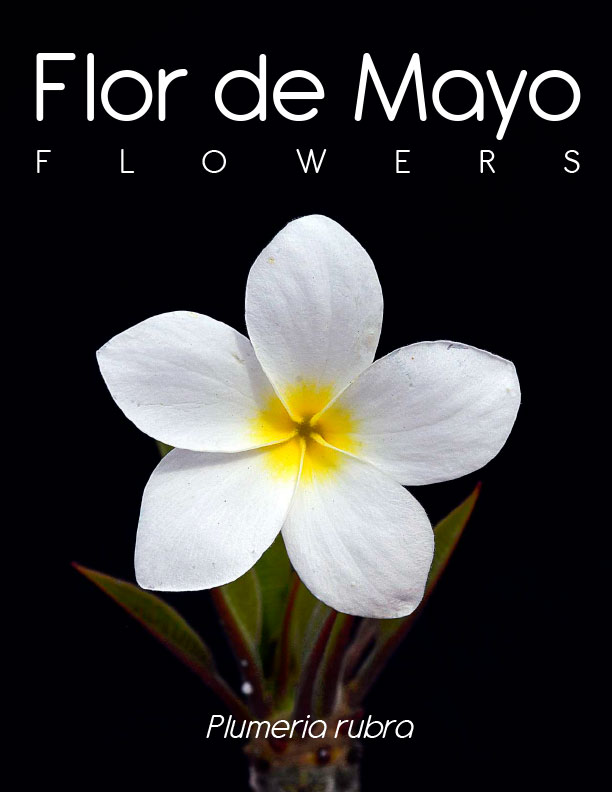
|
Flor de Maya Flowers, fine art giclee style close-up photos of frangipani flowers some pure red, others white with bright yellow centers. |
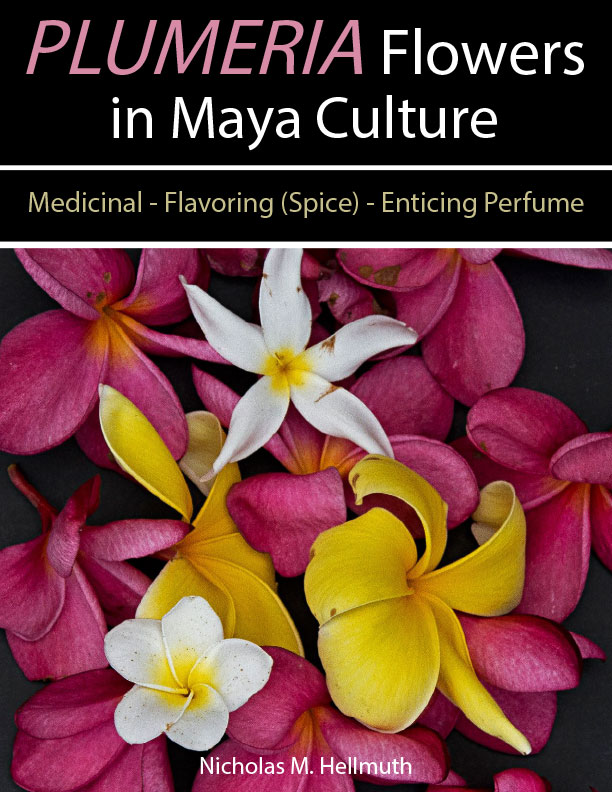
|
Plumeria Flowers in Maya Culture, medicinal, flavoring (spice), enticing Perfume. Gorgeous photos by Nicholas Hellmuth and by Sophia Monzon. |
|
Plumeria rubra Wild White Flor de Mayo, Frangipani Flowers up close, frangipani flowers in bosque seco (cactus desert-like area of Guatemala). |
|
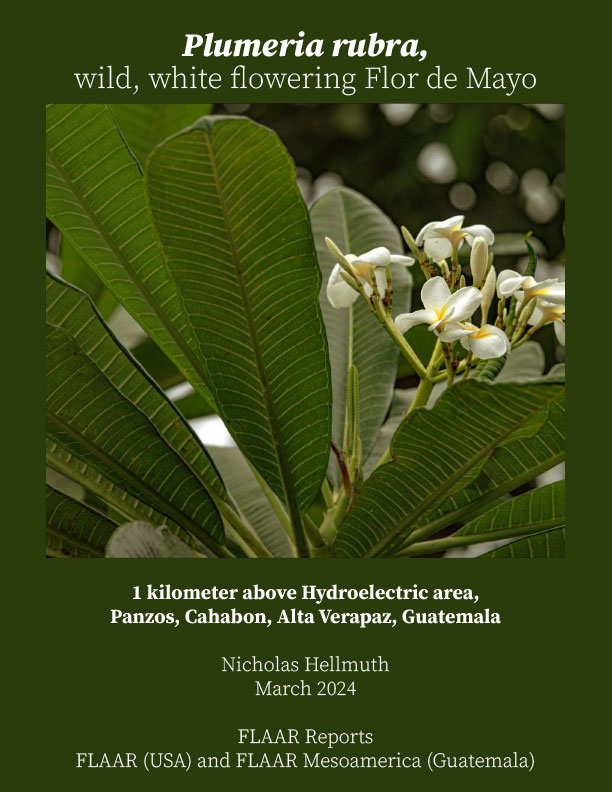
Plumeria rubra, wild, white flowering Flor de Mayo, Panzos, Cahabon, Alta Verapaz, Guatemala. Shows flowers plus entire shrub/tree. |
Most recently updated May 14 2025.
Updated May 25, 2010.
First posted Dec. 4, 2006. Updated August 24, 2009.