Ballcourt Architecture of Chichen Itza, Tikal, Copan, and Palenque. Nicholas has issued more than 9 reports on the pre-Columbian ballgames of pre-Columbian Mesoamerica.
Most discussions of the ballgame courts speak about the main playing alley and the rings (the “goals”). There is not much mention of the rest of the court. This FLAAR lecture on the ballgame architecture of Mayan ballgame courts (“ball courts”) provides more information and documentation than you receive when you are visiting the site as a tourist. It’s a lot easier in a PowerPoint presentation to bring in evidence from multiple ballcourt structures; this is tough to receive while you are visiting a Maya site.
 |
 |
|
Tikal Ballcourt, beside to Temple I, Great Jaguar, Tikal, Guatemala.
|
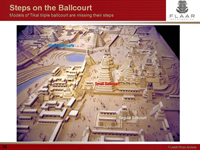
Model of Tikal indicate ballcourts.
|
 |
 |
|
Copan Ballcourt, Honduras.
|
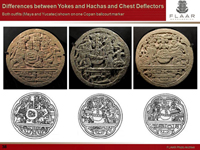
Copan Ballcourt Marker.
|
 |
 |
|
Chichen Itza, ballcourt.
|
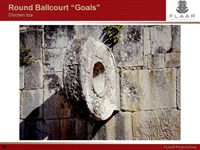
Ballcourt "Goals" of Chichen Itza.
|
Warfare and human sacrifice related to the Mayan ballgames.
Warfare could occupy many PhD dissertations and many tomes. One result of warfare was clearly to make victims available for human sacrifice. Whereas most captives were dispatched up in the temples, or on altars, or out in the plazas, a few of the captives were sacrificed associated with the ballgame. This leads to the disputed question of Was it the winner or loser who was sacrificed in the ballgame of Chichen Itza?
What were the Ballgames of the Maya, Toltec, and Aztec really Like? Who was sacrificed after the Ballgame? The Winner, or the Loser?
The popular myth is that because it was “an honor to be sacrificed to the gods” that the winner allowed himself to be sacrificed. Thousands of tourists are told this at Chichen Itza and many other Mayan sites that have ballcourts.
Anthropologists and archaeologists, however, use ethnohistorical documents to study this question. We read, and understand the Popol Vuh, for example (the 16 th century sacred history and religious history of the Quiche Maya of Guatemala). I have also worked on the predecessors of the Popol Vuh all the way back to the Early Classic (where Hunahpu is clearly pictured; Hunahpu is one of the Hero Twins of the Popol Vuh). This research is available in the ADEVA publication, Monster und Menschen in der Maya Kunst (circa 1987, so you can note that I have been working on iconography a long time, actually since 1965, the year I discovered the Tomb of the Jade Jaguar deep inside a pyramid near Temple II of Tikal).
So epigraphers, iconographers, archaeologists, ethnohistorians, and architectural historians have studied the ballgame of the Maya, the Aztec, etc. Sacrificing the ballplayer in the Popol Vuh is well documented. As we explain in the FLAAR lecture on the Maya ballgames, that it is very clear in the Popol Vuh who is sacrificed, the winner or the loser.
That’s why we have made the effort to prepare documentation for our lectures, to answer questions. If you have been to the archaeological sites in Mexico, Guatemala, Belize, and Honduras, and wish to understand the difference between fact and fantasy, bring an archaeologist to your home town, to your museum, college, university, local association, club. Have a local business sponsor this.
Hunting iconography of Mayan ballgames.
In the abundant 8 th-9 th century paintings on funerary vases that show the ballgames of the Maya, a relationship between the iconography of deer hunting and the iconography of certain Maya ballgames is clear.
Remember: there were many different ballgames played during these centuries. Not every ball was the same size; not every game was played for the same reason. The rituals, and costumes, of ballplayers varied considerably, depending on the purpose of this particular game event. These questions (and answers) are key aspects of the FLAAR lecture on the Maya ballgames.
There is plenty of documentation on this aspect of the game, so it’s time to clear up some of the misinformation that is based on imaginary concepts. Plus Nicholas is one of the few Maya archaeologists to be filed for PBS-TV actually wearing a yoke and playing the game.
Not only will you learn about what actually happened at Tikal , Chichen Itza, Palenque, Copan, etc, but you will understand how scholars document their discoveries.
Did all ballplayers wear a yoke?
There is probably more confusion (a polite way of saying there is a huge amount of misinformation and mistaken nomenclature) on the gear used in the ballgames of pre-Columbian Mesoamerica. This illustrated lecture documents the actual playing outfits from the 4 th through 9 th centuries, and how they varied depending on various factors.
 |
First posted February 2008.